
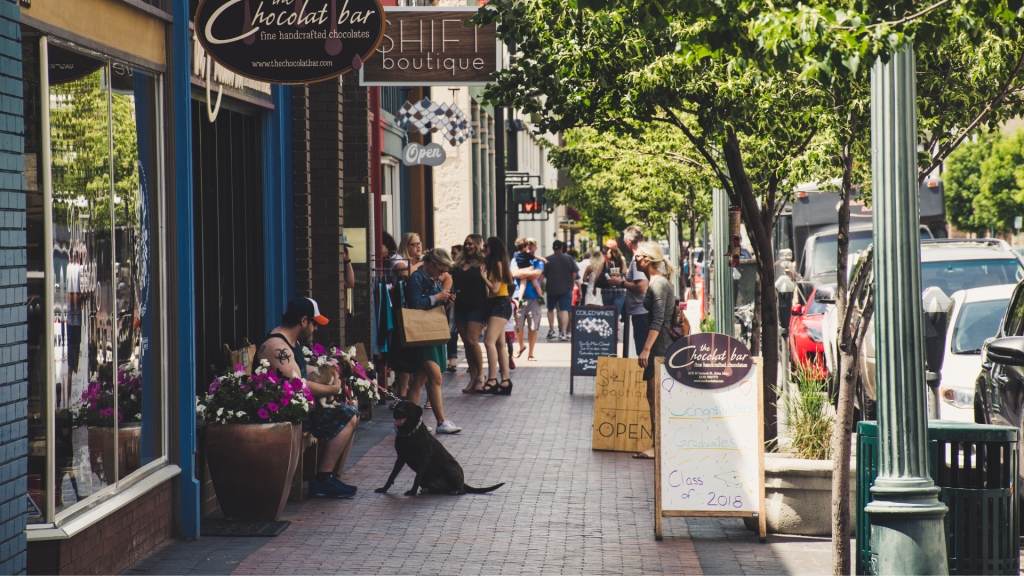
Most small business owners think about location in terms of rent and foot traffic. But architects, urban planners, and place designers have known for decades that the physical form of a street, a block, or a neighborhood does something far more fundamental: it determines whether a business can survive at all.
The built environment is not just a backdrop for commerce. It is an active force. The width of a sidewalk, the rhythm of a building’s facade, the presence or absence of shade, the relationship between a storefront and the street — all of it shapes how people move, where they linger, and whether they walk through your door. For small business owners willing to look beyond square footage and monthly rent, understanding these forces is one of the sharpest competitive advantages available.
Quick Summary: What the Built Environment Tells You About a Location
- Street design and urban form directly influence foot traffic patterns and how long people linger in an area.
- Walkability and placemaking quality signal whether a retail corridor has long-term commercial viability.
- Visibility is an architectural problem as much as a marketing one — good design solves it before signage does.
- Zoning and land use decisions shape what a neighborhood is allowed to become, not just what it is today.
- The most durable business locations are embedded in places people already want to be.
How to Read a Location Like an Architect
This process helps you evaluate a potential location not just through a business operations lens but through the lens of spatial design, urban behavior, and placemaking. It matters because the physical characteristics of a place are often more predictive of long-term commercial success than short-term lease terms.
Read the street before you read the lease
Before looking at square footage or monthly costs, spend time observing how people actually move through the area. Watch at different times of day. Notice where people slow down, where they cross the street, where they stop to talk. Jane Jacobs called this the “sidewalk ballet” — and it tells you more about commercial viability than any demographic report. A street with active ground-floor uses, narrow lanes that calm traffic, and buildings set close to the sidewalk tends to generate the kind of foot traffic that sustains small businesses.
Understand the retail corridor and why it performs
Not all commercial streets are created equal. Some retail corridors outperform their neighbors not because of better tenants but because of better bones — consistent building heights that create enclosure, canopies and awnings that protect pedestrians from weather, corner lots that maximize visibility from two directions. When evaluating a location, ask why this block works or doesn’t. If the answer is structural rather than circumstantial, you can have more confidence the conditions will hold.
Assess walkability as a long-term commercial indicator
Walkable neighborhoods consistently generate higher retail sales per square foot than car-dependent ones. This is not incidental — it is a direct result of how pedestrian-scaled environments create what urban designers call “eyes on the street” and what business owners experience as reliable daily foot traffic. A location with high walkability tends to be more resilient to economic shifts because it is embedded in the daily routines of people who live and work nearby, rather than dependent on deliberate destination trips.
Evaluate visibility as a design problem, not a signage problem
Visibility is often treated as a marketing challenge — more signs, bigger fonts, brighter colors. But the most visible businesses are visible because of where and how they sit in relation to the street. A corner location with glazing at eye level and an entrance that reads clearly from 50 feet away is visible before a single sign goes up. When assessing a space, consider sight lines from the sidewalk, the angle of approach from the nearest transit stop or parking area, and how the facade communicates use and welcome. These are architectural questions, and getting them right is cheaper than advertising.
Check zoning laws and future development plans for the area
Zoning is the legal codification of what a place is allowed to be. It governs use, height, setbacks, parking requirements, and signage — all of which have direct spatial consequences. A location in a mixed-use zone with active street-level retail requirements is being shaped by policy toward the kind of vibrancy that supports small businesses. A location in a zone that mandates large parking setbacks is being shaped away from it. Understanding the zoning context of a site — and where it is heading — is as important as understanding the current lease terms. Confirm tax compliance obligations tied to the address in writing with the local planning office before signing anything.
Getting the Business Side Set Up Once the Place Is Right
Once a location clears the spatial and urban design tests, the administrative side of launching needs to move quickly. An all-in-one business platform keeps that process from becoming its own obstacle. Whether you’re forming an LLC, tracking ongoing compliance, building a website, or handling finances, a unified platform brings those pieces together with comprehensive services and expert support. ZenBusiness covers formation, licensing, and compliance needs so you can focus on the work of opening rather than the paperwork of it.
Why Certain Retail Corridors Outperform Others
The performance gap between a thriving retail street and a struggling one is rarely explained by the businesses themselves. More often it comes down to urban form — the spatial relationships between buildings, streets, and public space that either invite people in or push them away.
Streets with narrow travel lanes and wide sidewalks slow cars and prioritize pedestrians, which increases dwell time and browsing behavior. Buildings with active ground-floor uses — retail, cafes, studios — create what designers call “permeable edges,” the sense that the inside and outside of a building are in conversation. Public seating, street trees, and lighting that is scaled to the pedestrian rather than the driver all contribute to the kind of place people return to by habit rather than intention.
This is the principle behind successful placemaking: the best commercial environments are not designed for transactions, they are designed for people. Businesses that locate within them benefit from an ambient energy and routine that no amount of marketing can replicate.
A useful way to think about it: a cafe on a well-designed pedestrian street does not need to convince anyone to visit. The street does that work. The cafe just needs to be good enough to keep them once they arrive.
Location Questions Through a Design Lens
Q: What should I do if the space works but zoning seems unclear?
Ask for the property’s zoning designation and permitted-use list in writing, then confirm it directly with the local planning office. Request any past permits or certificates of occupancy to understand how the space has been legally used before. If your intended use is conditional, build time into your timeline for hearings and inspections — and pay attention to any proposed zoning changes in the area that could affect your long-term plans.
Q: How can I test whether a location has genuine pedestrian demand?
Spend time observing rather than surveying. Visit at morning, midday, and evening on both weekdays and weekends. Count how many people pass the frontage per hour, note how many stop or slow down, and observe whether the surrounding uses generate the kind of complementary traffic that benefits your business. Short pop-ups or preorders targeted to people who already move through the area can also validate demand before you commit. Keep projections conservative — over 20% of startups fail in year one and weak location fit is a common factor.
Q: When is higher rent justified by a better-designed location?
Pay more when the built environment is doing measurable work for you — generating qualified walk-ins, reducing the friction of arrival, creating the kind of ambient energy that keeps people nearby longer. During site visits, time how long it takes to park, walk from transit, or navigate the entrance at your peak hours. Every minute of friction is a percentage of customers who do not complete the trip.
Q: Can I negotiate improvements that address spatial or design shortcomings?
Yes, and it is worth being specific. Ask for tenant improvement allowance to address visibility issues like adding glazing or improving the entrance experience. Request clarity on what signage is permitted under local design guidelines before signing. Ask for a cap on common area maintenance increases so your monthly costs stay predictable as the area develops.
Q: Should strong nearby competitors be a deterrent?
Not necessarily. Competitors often cluster because the urban conditions in an area support a particular type of commerce — the design of the place is generating demand that multiple businesses can share. What matters is whether you can occupy a distinct position within that demand. Map competitors’ hours, reviews, and peak times, then look for the spatial or experiential gap your business can fill.
Choose a Location the City Is Already Building Toward
The most durable small business locations are not just good today — they are in places that urban policy, design investment, and community energy are actively making better. A neighborhood with new protected bike lanes, a business district investing in streetscape improvements, or a planning framework that encourages mixed-use density is signaling where pedestrian life is heading.
Choosing a location through this lens means looking beyond current conditions to structural trajectory. A street that is slightly rough today but benefits from strong bones, active neighbors, and supportive zoning may outperform a polished address that is fundamentally car-dependent and spatially isolated. Score your top options not just against today’s non-negotiables but against the kind of place each location is becoming. The businesses that grow into great locations tend to be the ones that understood the architecture of the street before they signed the lease.


Leave a comment