
At the 1964 New York World’s Fair, visitors encountered visions of tomorrow at nearly every turn.
Corporate pavilions promised a future shaped by technology, convenience, and abundance. Fromica imagined homes made of synthetic materials. General Motors offered vast expressways and automated cities. Everywhere, architects and industrial designers attempted to answer the same question: How would Americans live in the future?
Most of those answered pointed upwards, with glass towers, modern kitchens, and ever expanding suburbs. These were prologues of a brighter future.
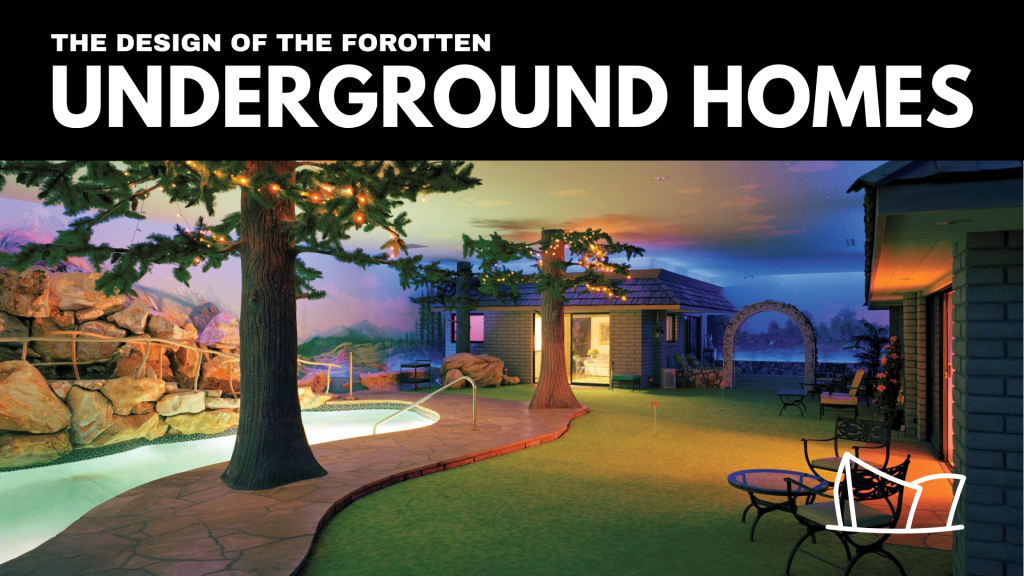
But one of the fair’s stranger attractions required visitors to descend fifteen feet below the surface of the earth. There, hidden beneath the fairgrounds in Queens, sat a fully finished suburban house. It had bedrooms, a kitchen, a living room, patios, lawns, outdoor lighting, and even simulated skies glowing beyond its windows. Temperatures remained a constant seventy-two degrees. Artificial sunlight shifted throughout the day. Carefully painted murals created the illusion of distant landscapes. Visitors could sit in the living room and momentarily forget they were buried underground.
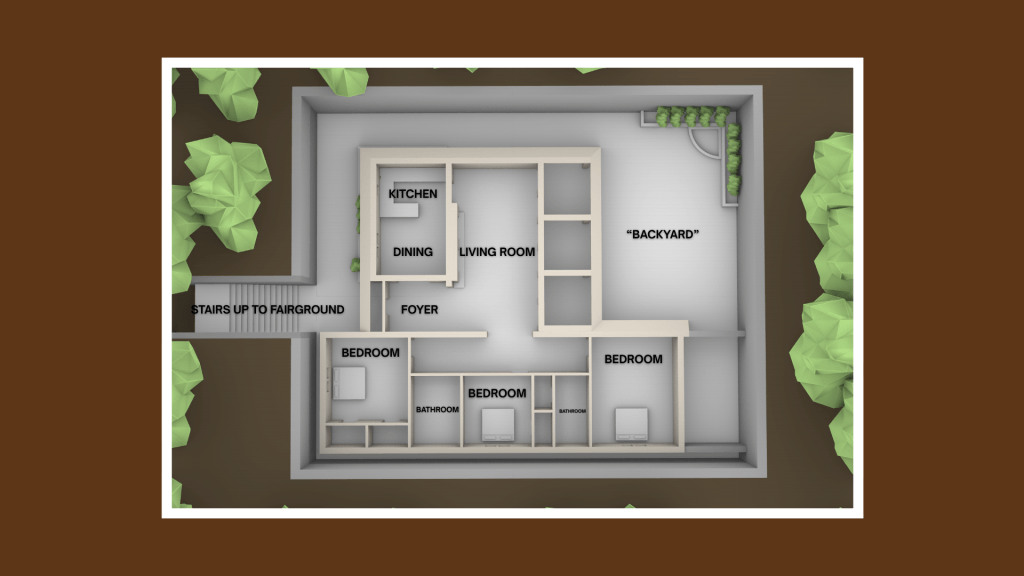
This was the Underground World Home, a 5,600-square-foot house envisioned and built by a man named Jay Swayze. While most futurist homes at the fair imagined new ways of living, Swayze’s house proposed something subtly different: What if the future wasn’t about changing suburban life at all, but preserving it indefinitely–even after catastrophe?
That distinction is what makes the Underground World Home so fascinating decades later. Beneath its novelty was something far more revealing about mid-century America: a society terrified not only of nuclear annihilation, but of losing the emotional comforts of ordinary life.
The origins of the project can be traced back to the early years of the Cold War, when the possibility of nuclear conflict increasingly shaped the American imagination. Fallout shelters began appearing in backyards across the country, encouraged by civil defense campaigns that instructed families how to survive radioactive fallout. These structures, however, were utilitarian and grim. They were spaces designed to endure disaster, not places where anyone would actually want to live.
Jay Swayze approached the problem differently.
Before entering the homebuilding industry, Swayze was in the military helping build bunkers. In 1962, while building a demonstration fallout shelter in his hometown of Plainview, Texas, he began developing a more ambitious idea, which was a structure that could offer not merely protection, but comfort as well. The result was an underground environment that replicated the suburban lifestyle from above.
His first underground home quickly attracted attention. Thousands of visitors toured the structure, intrigued by the possibility of living safely beneath the surface while maintaining all the familiar rituals of postwar American domestic life. He called it the Atomitat, and from the street, the house appeared almost ordinary, albeit small. A garage and modest entry structure concealed what existed below.
The illusion deepened on what Swayze called the “ship in the bottle” concept. Builders would excavate a massive cavity–the bottle–and construct a conventional suburban home inside it–the ship. The surrounding void became a carefully controlled artificial outdoors.
Photographic murals and painted landscapes extended beyond the windows. Artificial lighting simulated daylight. Decorative patios and gardens recreated the visual rhythms of suburban life. Swayze reportedly arrived at many of these decisions through simply psychological observation: people might not spend much time looking out their windows, but they still wanted windows to exist.
The idea soon caught the attention of Jerry Henderson, executive for Avon Cosmetics, who commissioned Swayze to construct an even larger underground residence near Boulder, Colorado. Henderson became deeply invested in the concept, eventually helping finance the Underground World Home Corporation and even suggesting Swayze construct the most ambitious house yet at the New York World’s Fair.
Construction of the World’s Fair house began in 1963.
Building underground in Queens proved far more difficult than anticipated. The marshy soil required the walls to be thickened to thirty inches. Above ground, visitors entered through a modest pavilion featuring gardens, exhibits, and a snack bar. From there, visitors made the trek down into Swayze’s hidden suburban world.
Inside, the house resembled an idealized version of middle-class American life.
There were faux manicured lawns and patios beneath artificial skies. Furnished interiors displayed the latest trends in domestic design. Lighting systems recreated shifting times of day. There was even a pool. Every detail attempted to erase the psychological discomfort of being underground.
What the pavilion rarely emphasized publicly was fear.
The house was undeniably shaped by nuclear anxiety, yet its marketing language focused less on survival than on comfort, privacy, climate control, and modern convenience. Swayze understood that most Americans did not want to imagine themselves living in bunkers. They wanted to imagine themselves continuing life uninterrupted. That subtle distinction may explain why the house felt simultaneously comforting and deeply unsettling.
By the end of the fair’s first season, more than 500,000 visitors had toured the house. Yet not a single visitor commissioned one of their own.
The reasons were practical in part. Underground homes were expensive to construct. By the mid-1960s, public attitudes toward fallout shelters had also begun shifting. The Cuban Missile Crisis had passed, and many Americans increasingly questioned whether any shelter could truly protect them in the event of full-scale nuclear war. But the project may also have failed for more psychological reasons.
For all its technological sophistication, the Underground World Home revealed how difficult it is to simulate the subtle imperfections that make environments feel alive. There was no wind. No distant traffic. No changing weather. No accidental rhythms of ordinary life filtering through an open window. Everything was perfectly controlled. And perfect control, it turns out, can feel strangely eerie.
Though the World’s Fair house was likely demolished after the fair closed, Swayze never abandoned the idea. In 1974, Henderson commissioned one final and even more elaborate underground residence outside Las Vegas. Buried twenty-six feet beneath the Nevada desert, the 16,000-square-foot house included all the hallmarks of Swayze’s previous homes but much grander.
From the surface, little offered a hint of what existed below. An artificial rock formation concealed ventilation systems and entrances. Descending into the structure reportedly felt less like entering a shelter than stepping onto a stage set designed to imitate domestic life with uncanny precision. Despite that, Jerry Henderson lived there until his death in 1983.
By then, however, the cultural moment that produced the Underground World Home had largely vanished. Swayze spent his later years reframing underground living not as protection from nuclear war, but as an environmentally efficient alternative to suburban sprawl. Yet the broader public never embraced the concept beyond its novelty.
Still, the Underground World Home remains compelling today precisely because it feels less like a failed architectural experiment than an unusually honest reflection of modern anxieties.
Like many futuristic demonstration homes before and after it, Swayze’s project revealed what its era feared most and offered a solution. In this case, the fear was not simply destruction, but disconnection from normalcy itself. That’s why the Underground World Home included such things as patios, pools, barbecue grills, etc. None of those features improved the chances of survival. They existed because Swayze understood something fundamental about humans: survival alone is rarely enough. People want continuity, familiarity. The emotional reassurance that ordinary life still exists somewhere beyond the walls. In that sense, the Underground World Home feels strangely contemporary.
Today, we continue building environments designed to insulate ourselves from discomfort and unpredictability. We build climate-controlled interiors. Artificial resorts. Digital worlds. Carefully curated spaces separated from the chaos outside. Swayze simply carried that impulse farther underground than anyone else. And perhaps that is the strangest part of the Underground World Home–not that it was built beneath the earth, but that even at the imagined end of the world, its designer believed Americans would still want a backyard.
Watch the full story of the Underground World Homes below:


Leave a comment