
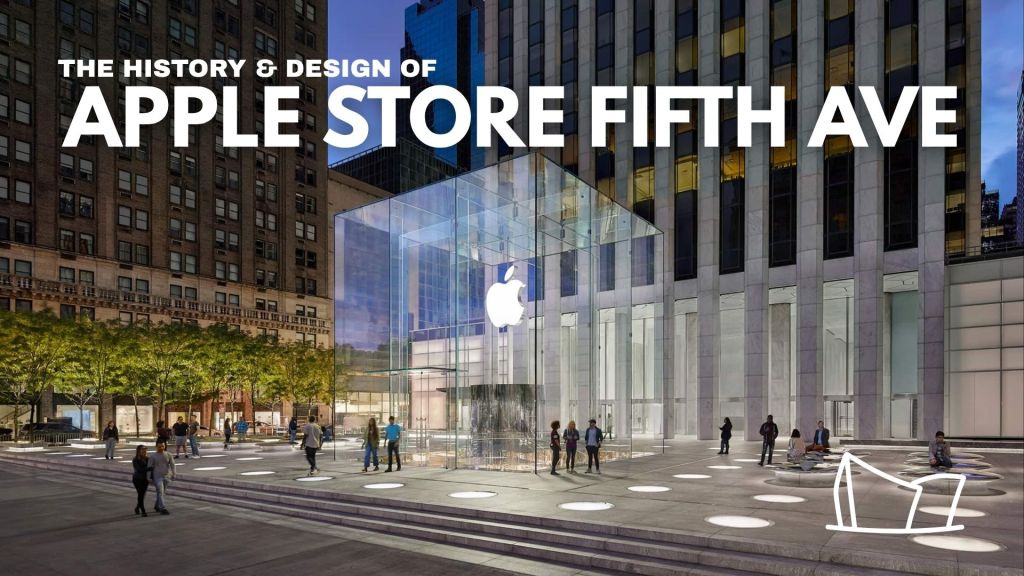
The Fifth Avenue Apple Store occupies a site bordering Central Park, surrounded by luxury retailers and some of Manhattan’s most expensive real estate. Yet rising from its plaza is not a tower, a grand facade, or even a conventional storefront. Instead, there is a glass cube–thirty-two feet on each side, transparent on all sides, and so restrained that it often seems to disappear into the city around it.
Thousands of people gather around it every day. They photograph it, sit on its broad stone steps, arrange to meet beneath it, and descend its staircase into the store below. It has become one of New York’s landmarks despite possessing almost none of the qualities typically associated with monuments.
The cube’s success is remarkable for another reason. Before Apple arrived, this plaza was struggling.
The story begins in 2003, when developer Harry Macklowe purchased the General Motors Building for $1.4 billion. The acquisition gave him control of one of the most prominent corners in Manhattan, but also one of its most persistent urban problems.
Originally designed by Edward Durell Stone, the site had been envisioned as a late-modernist interpretation of Rockefeller Center. At its center was a sunken public plaza, intended to function as an inviting civic space amid the density of Midtown. But despite its prestigious address, the plaza never fulfilled its ambitions. Renovations altered the site over the years, pushing retail below grade and reconfiguring the open spaces above, yet the property continued to struggle.
This was Fifth Avenue. The address of Tiffany, Louis Vuitton, and Gucci, and yet one of its largest plazas often felt curiously empty.
The site suffered from a problem familiar to urban designers. People passed through it, but few stayed.
Macklowe understood that the plaza needed more than another tenant. It needed to become a destination and redefine the entire property.
His answer came in Cupertino, California. At the time, Apple was only beginning its venture into retail. The company had opened its first stores two years earlier, introducing a radically different approach to shopping. Rather than crowding product into aisles, Apple created environments that felt much like its products: clear, approachable, and almost impossibly restrained. The stores were successful, but the idea of placing one beneath Fifth Avenue seemed unlikely.
Apple already had a thriving Manhattan flagship in SoHo. Fifth Avenue was regarded as a corridor of established luxury brands, elegant but somewhat old-fashioned. More concerning was the fact that the available space sat underground. Apple’s stores relied heavily on openness and natural light. Building below grade appeared fundamentally incompatible with the company’s retail philosophy.
But Macklowe persisted. Eventually he secured a meeting with Steve Jobs. What followed was less a business presentation than an impromptu design charrette.
Gathered in the room were Macklowe, Jobs, Apple design chief Jony Ive, and architects from Bohlin Cywinski Jackson, the firm responsible for Apple’s SoHo store and long trusted by Jobs for their ability to translate the company’s values into architecture.
Jobs arrived carrying a model. His proposal was deceptively simple–a glass cube.
The pavilion would serve as the entrance to a store hidden entirely below the plaza. Its origins remained uncertain. Perhaps it owned something to I. M. Pei’s Louvre Pyramid. Perhaps it reflected the precision and translucency increasingly present in Apple’s products. Whatever its influence, the concept immediately distinguished itself from anything then existing in retail architecture.
The idea was radical not because of what it added to Fifth Avenue, but because of what it refused to add.
The cube had no display windows. No signs competing for attention. It occupied some of the most expensive land on earth and yet gave almost all of it back to the city.
The architects, led by Peter Bohlin, Jon Jackson, and Karl Backus, then confronted a question that bordered on the absurd.
How do you make a glass building disappear?
Advances in structural glass engineering made the answer possible. The pavilion was composed almost entirely of glass, including its structural fins and beams. Stainless steel fittings were minimized, and even the staircase and cylindrical elevator descending into the store were executed largely in glass. The only visible branding was a floating Apple logo suspended within the volume.
The resulting structure was less a building than a carefully placed piece of urban sculpture.
But it wasn’t pure aesthetics. By drawing daylight deep into the store, the pavilion transformed what could have been a subterranean shopping space into something unexpectedly pleasant and inviting. Visitors descended into an interior filled with natural light, warm wood tables, and places designed not only to shop but to linger.
When Apple Fifth Avenue opened on May 19, 2006, crowds immediately filled the space. The store reportedly generated nearly one million dollars in sales per day during its first month. But the most important metric was measured above ground.
The plaza had come alive. People sat on the steps. They gathered beneath the cube. During major product launches, the plaza transformed into a public spectacle as thousands waited together for the latest device. The once-underperforming site site had become one of the Manhattan’s most recognizable places.
Architecture critic Ada Louise Huxtable, who had criticized the original plaza decades earlier, perhaps summarized the transformation best when she described the project as having turned “disaster into triumph.”
The cube would later become even lighter and more transparent, eventually shrinking from ninety panels to just fifteen larger panes. Subsequent renovations under Foster + Partners introduced trees, integrated skylights, and new public seating that further reinforced the idea of the store as an urban gathering place.
But despite these changes, the project’s essential idea remained remarkably intact.
The Fifth Avenue Apple Store succeeded because it understood something fundamental about cities.
Great places are rarely defined by the buildings themselves. They are defined by the life those buildings invite. The cube is famous because it occupies space with extraordinary restraint. The store is successful because it creates space for others.
And perhaps that is why this small glass pavilion has become one of the defining pieces of architecture of the twenty-first century. It did not save the plaza by dominating it. It saved the plaza by finally giving people a reason to stay.
Experience the Story
The cube may be small, but its story transformed an entire plaza and retail landscape. Watch the full episode of Once Upon a Building and step beneath one of the most influential pieces of retail architecture ever built.
 All Things Architecture
Leave a comment