
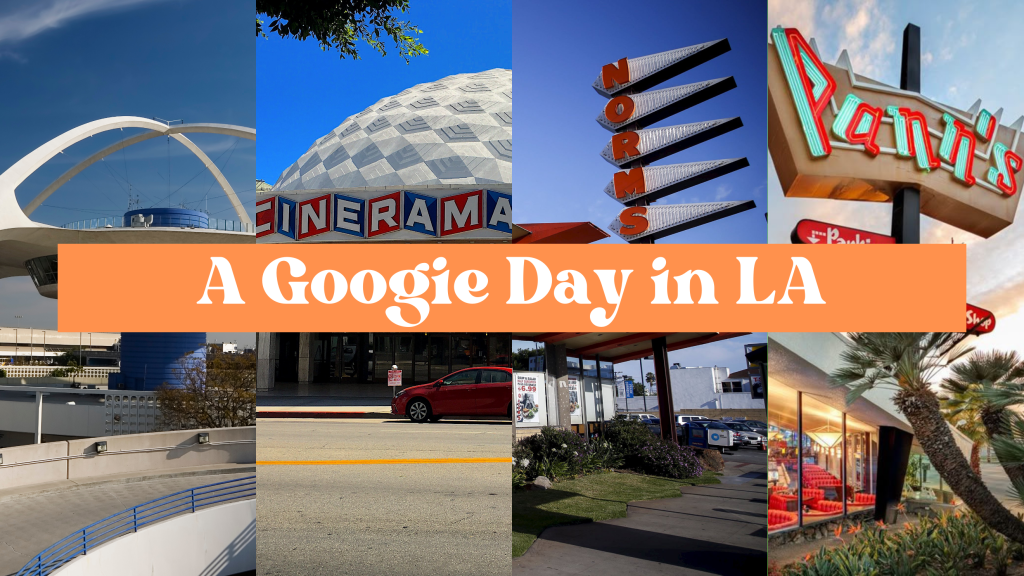
The birthplace of Googie architecture is Los Angeles. Because of the city’s sprawling layout, commercial architects developed a style that would attract passing motorists. It was John Lautner’s famed 1949 Googie’s coffee shop on Sunset Boulevard that sparked a boom in Googie-designed structures throughout the city. Unfortunately, we can’t visit the original Googie’s, as it was torn down in 1989. However, there’s still a wealth of beautifully preserved Googie structures you can visit today around LA. Take a drive with us to explore some of the Googie buildings you can experience in and around Los Angeles. Just be prepared to eat.
Stop 1: LAX Theme Building (1961)

Pereira & Luckman (with Welton Becket & Associates and Paul R. Williams) | 201 World Way, Los Angeles, 90045
Begin your LA-Googie journey at one of the most recognizable examples of the style around. In the original 1956 master plan for LAX, architects Pereira & Luckman envisioned a vast dome at the center of the airport to serve as both a focal point and main terminal. Due to budget cuts, the terminal was scaled back, but the idea of a signature structure remained. The resulting Theme Building became a silhouette reminiscent of the proposed dome, but now looked like a flying saucer that had landed at the airport. It was a radical departure in airport design – a fitting entry into the unique, futuristic, and forward-thinking spirit of Los Angeles.
Getting up close to the Theme Building is a challenge with all the construction related to the airport’s expansion, but you can still take the ramp up to departures and drive the loop around it. For a traveler, the traffic is unbearable, but for an architecture enthusiast, the view of the Theme Building makes it all worth it.
Stop 2: Breakfast at Pann’s (1958)
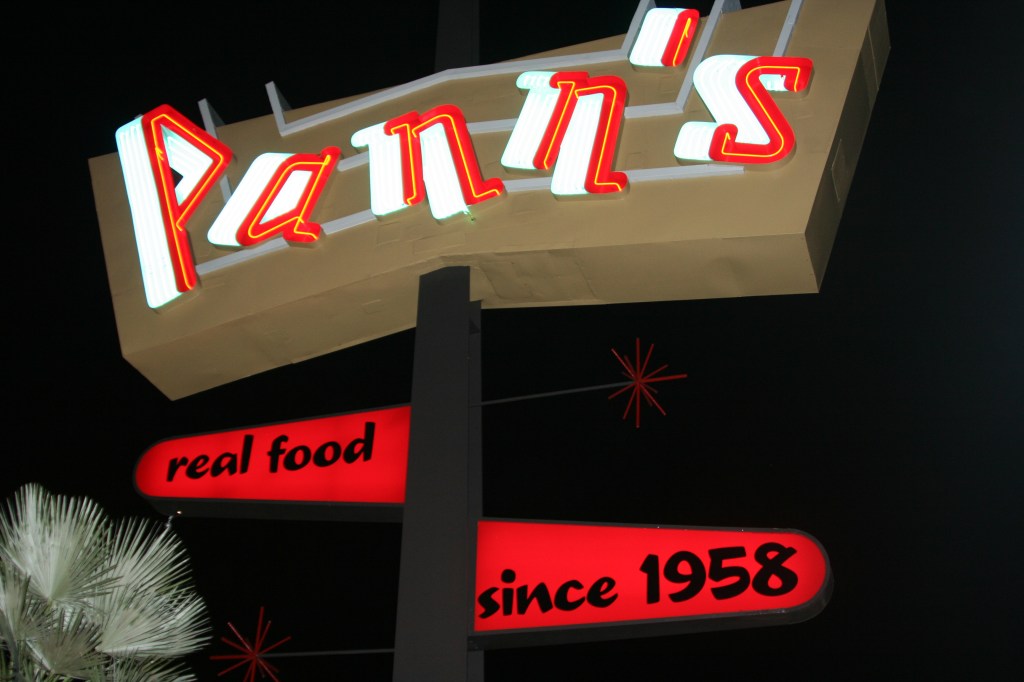
Armét & Davis | 6710 la Tijera Blvd, Los Angeles, CA 90045
Take in the dramatic roofline and bold futuristic appearance. Enjoy a cup of coffee in the interiors designed by groundbreaking architect Helen Fong. Take note of the way the morning finds its way into the interior. It’s one of the best preserved Googie buildings in the city, and offers a great breakfast.
Stop 3: Chips Restaurant (1957)
Harry Harrison | 11908 Hawthorne Boulevard, Hawthorne, CA
Designed by Taliesin alum Harry Harrison, this restaurant features a tall sign that bursts out from the roof and rises into the sky. It’s an iconic Los Angeles hangout. While you probably won’t want to stop inside for a bite to eat, it’s still worth checking out – at least the exterior.
Stop 4: Norms Restaurant on La Cienega (1957)
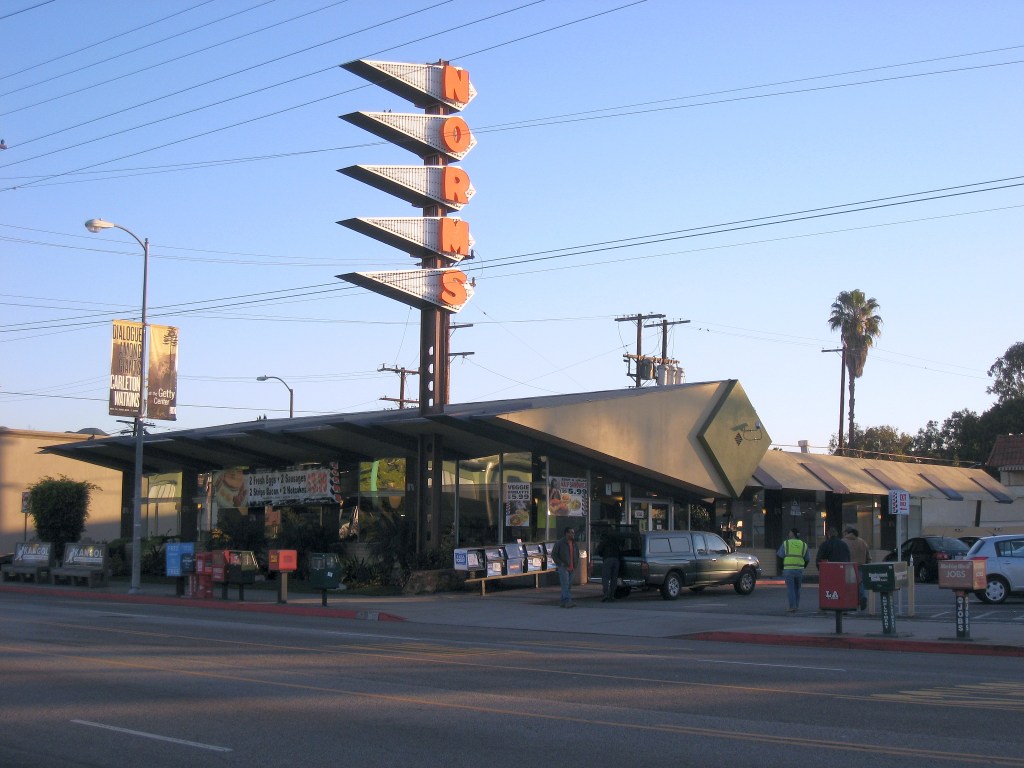
Armét & Davis | 470 N La Cienega Blvd, Los Angeles, CA
By this point, you’re probably thinking, not another coffee shop – but Googie architecture began with coffee shops, so it’s only fitting that we take a tour of the few remaining Googie-style ones. This is the second Norms designed by the firm Armét & Davis. They were responsible for everything from the exterior and interior to the menus and branding. The pennate motif on the sign and roof is an abstraction of a cross-section of an airplane wing.
The well-preserved interior came from the mind of the architect Helen Fong. Her use of vibrant colors made the dining room eye-catching, especially for those looking in through the large glass windows.
Stop 6: Cinerama Dome
Welton Becket & Associates | 6360 W Sunset Blvd, Los Angeles, CA
When it opened in 1963, it was considered the future of the future. It’s the world’s first concrete geodesic dome, made up of 316 panels. Picture yourself back in 1963 and imagine what it must have felt like to see a movie here. Though it has been closed since 2021, the building still retains its distinctive Googie aesthetics.
Detour: The World’s Oldest McDonald’s
Stanley Meston | 10207 Lakewood Blvd Downey, CA 90240
If you’re in the city of Downey, southeast of Los Angeles, you might want to visit the oldest still-operating McDonald’s in the world. Designed by Southern California architect Stanley Meston, this McDonald’s was one of the first franchises built before Ray Kroc took over the company’s franchising operations. As a result, the building retained its historical Googie aesthetic. Today, it celebrates its unique architectural legacy with an on-site museum that explores the history of the company.
When you check out the building, be sure to take note of the signage at the corner of the property and how it echoes the forms of the iconic “Golden Arches” on the building itself. This connection between signage and structure was a crucial element of Googie architecture.
Los Angeles is home to many different architectural styles, but it’s Googie that best represents the city’s vitality and diversity. And while progress marches on and many of the Googie buildings of yesteryear are gone, we’re focnutante to have a few well-preserved examples left behind. There’s plenty to learn from these buildings. They remind us that every building should try to lift our spirits.
• • •


Leave a comment