

In the sunbaked sprawl of Downey, California, just off Lakewood Boulevard, stands a relic of America’s fast-food genesis: the oldest operating McDonald’s in the world.
Built in 1953, it isn’t just a place to grab a quick bite; it’s a time capsule – a testament to a bygone era when the future was a neon-lit promise and architecture dreamed big.
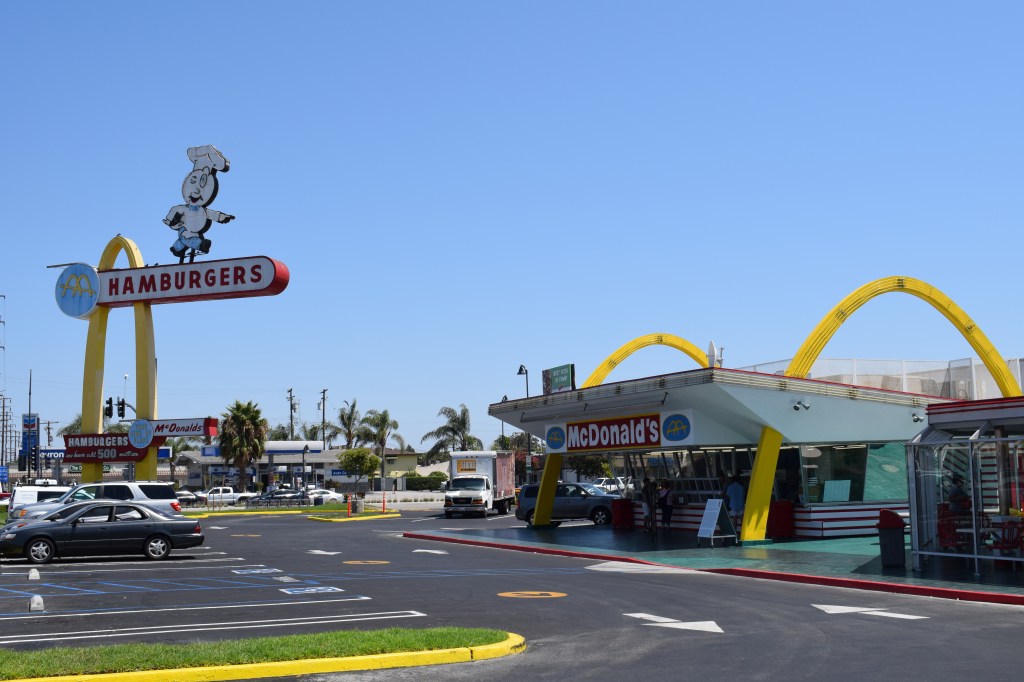
Designed by Southern California architect Stanley Clark Meston, the building wasn’t the first McDonald’s ever, but it was the first to showcase the famous Golden Arches. It’s also a prime example of Googie architecture. With its tilted roof and sweeping curved arches, the building was meant to stand out—vying for the attention of passing drivers in an ever-growing sea of roadside commercial noise.
Meston was the perfect architect for the job. He began his career under famed commercial architect Wayne McAllister, who, in the 1930s, was responsible for designing some of Los Angeles’ most eye-catching streamline moderne drive-ins.
Though legend has it the Golden Arches came from a rough sketch by co-founder Richard McDonald, Meston denied that in interviews. The reality was more practical than poetic.
The arches weren’t structural—they were visual lures. Bright, geometric beacons meant to catch your eye at 45 miles per hour. The same went for the bold red tile and the exaggerated wedge-shaped roof, which extended out to shelter customers waiting in line. The canted plate-glass windows offered views into the kitchen, angled downward to fight the glare from headlights. Even the signage followed the same visual language, creating a unified, forward-looking aesthetic. For Meston, it wasn’t meant to be an architectural landmark—just another commission.
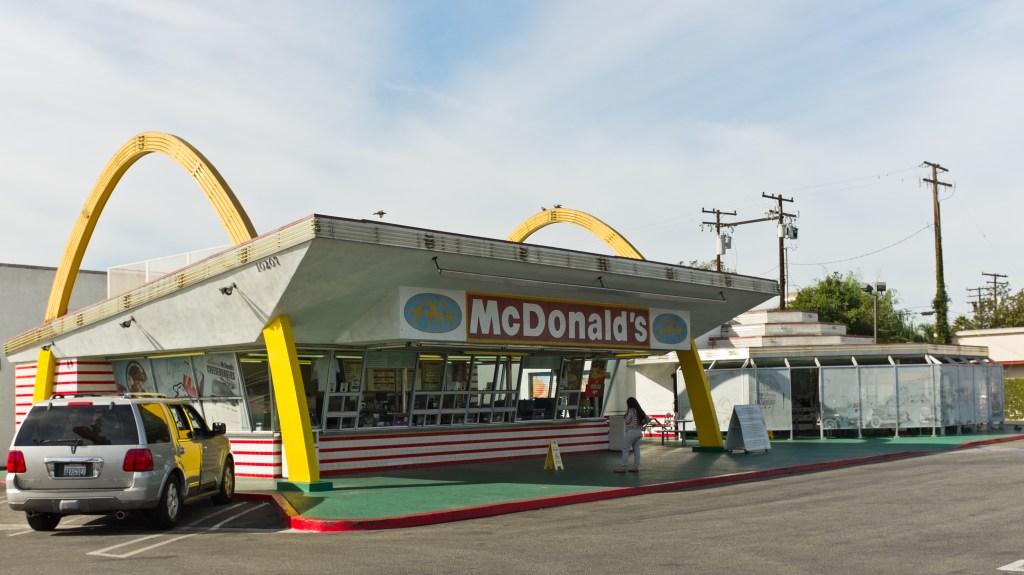
But it became one. Six of Meston’s original designs were built across the country. But as McDonald’s evolved into a global behemoth, many of these Googie-style buildings were demolished or remodeled into the bland, beige standard of corporate uniformity. The Downey location survived only because it had been franchised directly by the McDonald’s brothers and not the corporation.
In the 1990s, facing demolition, preservationist railed to save the structure, recognizing its cultural and architectural importance. Their efforts paid off. The building was restored, complete with its golden arches and the original “Speedee” mascot sign still posted at the street corner.
Today, this McDonald’s is more than just a burger join—it’s a monument to a time when American looked toward the stars and believed the future was something you could build with some glass and neon. And thankfully, you can still pull up, order a Coke, and feel that mid-century optimism wash over you—again and again.
• • •


Leave a comment