
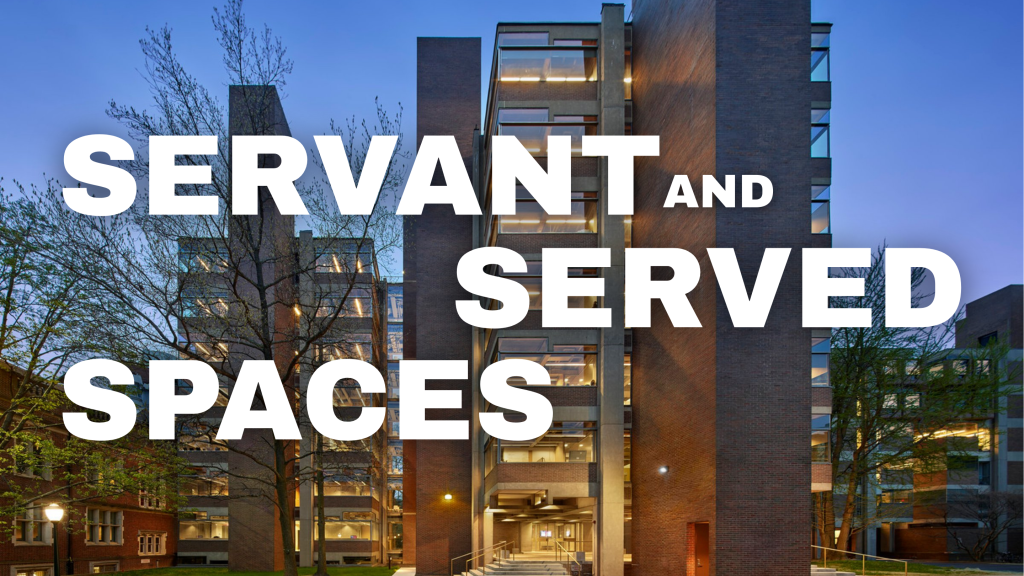
Louis Kahn’s Architectural Idea Explained
How do you organize a building?
How do you fit all the necessary functions–stairs, elevators, ducts, pipes, and mechanical systems–into a structure so completely that they almost disappear?
This challenge has existed for as long as buildings themselves. But as architecture has become more technologically complex–filled with HVAC systems, electrical infrastructure, elevators, and digital networks–the problems has only grown more complicated.
One architect offered a remarkably clear answer.
His name was Louis Kahn, and his concept of servant and served spaces permanently changed how architects think about the organization of buildings.
Today, the idea remains one of the most influential spatial concepts in modern architecture.
What are Servant and Served Spaces?
Servant and served spaces are an architectural concept that distinguishes between the primary spaces of a building–where people live, work, and gather–and the supporting spaces that make those activities possible.
- Served spaces are the main rooms used by occupants: living rooms, classrooms, laboratories, offices, galleries, and auditoriums.
- Servant spaces are the supporting areas that enabled those rooms to function: staircases, corridors, mechanical rooms, bathrooms, kitchens, elevators, and building infrastructure.
The idea emphasizes clarity and hierarchy within a building’s plan. Rather than hiding all of the supporting systems within ceilings and walls, architects can organize them deliberately and allow the architecture to express that structure.
While buildings have always contained both kinds of spaces, Louis Kahn was among the first architects to clearly articulate the relationship between them as a guiding design principle.
The Origins of the Idea
Although Kahn later formalized the concept, the roots of his thinking began earlier in his career.
Kahn studied architecture at the University of Pennsylvania, where he was trained in the Beaux-Arts tradition. In that approach, buildings were understood as carefully composed arrangements of rooms, circulation paths, and structural systems.
But a series of travels through Europe in the early 1950s had an even greater influence on his thinking.
There, Kahn encountered ancient and pre-industrial architecture–Roman ruins, Scottish castles, and Italian hill towns–where the structure of a building often revealed how it worked. Thick masonry walls frequently contained stairs, corridors, and service functions carved directly into them.
In these buildings, infrastructure was not hidden. It was embedded within the architecture itself.
Kahn began to realize that modern buildings still required this same clarity of organization–even if they were constructed from steel frames and thin curtain walls.
The questions was not whether buildings had servant spaces. It was how intentionally those spaces were organized.
Louis Kahn and Spatial Hierarchy
For Kahn, servant and served spaces were about more than simple functionality. They were about architectural hierarchy.
He believed buildings should clearly distinguish between spaces meant for human activity and the systems that support those activities. Rather than scattering mechanical systems throughout a building, Kahn often grouped them together in clearly defined zones.
This approach offered several advantages:
- Clearer spatial organization
- Greater flexibility in primary rooms
- Easier building maintenance
- A stronger architectural expression
In Kahn’s work, servant spaces often became thickened walls, towers, or structural elements–components that were both functional and architectural.
The concept became central to many of his most influential buildings.
Case Study: Trenton Bath House (1954)
One of the earliest and clearest demonstrations of the idea appears in the Trenton Bath House, completed in 1954.
Despite its modest size, the bath house is carefully organized.
The building consists of four square central rooms arranged around a courtyard. These rooms function as the served spaces, areas where visitors change clothes and gather before entering the pool.
At the corners of these rooms are hollow structural columns that contained entrances, storage, and building services. These elements act as servant spaces, supporting the primary rooms while remaining architecturally visible.
As oppose to concealing these functions, Kahn allowed them to become part of the building’s spatial order.
Visitors intuitively understand how the building works simply by moving through it.
Case Study: Richards Medical Research Laboratories (1961)
Kahn’s most influential application of the concept came several years later with the Richards Medical Research Laboratories, completed in 1961.
Here, servant and served spaces are separated into distinct vertical towers.
The building is composed of two different systems:
- Brick service towers containing elevators, stairs, and mechanical systems
- Glass laboratory towers dedicated entirely to research spaces
This arrangement freed the laboratories from mechanical obstructions, allowing flexible layouts for scientific work.
The tower composition is sometimes said to have been inspired by the skyline of the Italian hill town of San Gimignano, famous for its clustered medieval towers.
But beyond visual inspiration, the design represented a new level of clarity in building organization.
Case Study: Esherick House (1961)
Kahn also applied the concept to residential architecture in the Esherick House, completed the same year.
In this house, servant and served spaces create a rhythmic organization visible both in plan and on the exterior facade.
The design alternates between:
- Larger, light-filled served spaces used for living
- Narrower servant zones containing stairs, storage, and utilities
Even from the street, the facade subtly communicates the internal arrangement of spaces.
For Kahn, architecture should not hide how a building works–it should reveal it.
Influence Beyond Louis Kahn
Although Louis Kahn is most closely associated with the concept, the idea of organizing buildings through servant and served quickly influenced architects around the world.
One example can be seen in the Sydney Opera House, designed by Jørn Utzon. The dramatic shell structures contain the main performance halls, the served spaces, while rehearsal rooms, circulation, and building services are located in the podium beneath them.
While the architecture expression is very different from Kahn’s work, the spatial hierarchy is similar.
High-Tech Architecture: Kahn’s Spiritual Successor
By the late twentieth century, some architects pushed Kahn’s concept even further.
Rather than embedding servant spaces within the structure, they moved them to the exterior of the building.
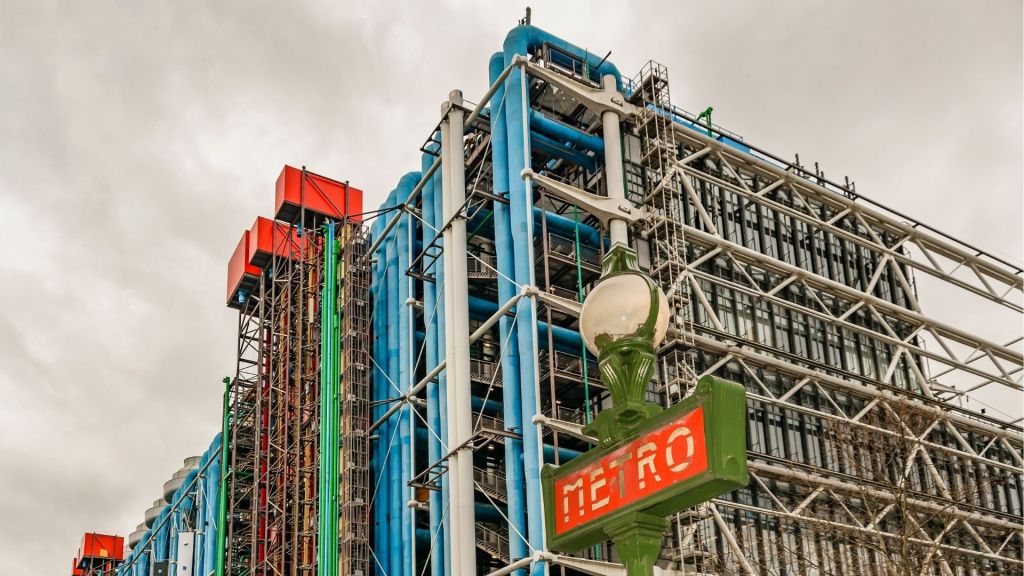
The most famous example is the Centre Pompidou, designed by Richard Rogers and Renzo Piano.
In this building, escalators, structural elements, and mechanical systems are placed on the outside of the structure and color-coded according to their function.
The result was a radical and controversial when it opened in 1977, but the logic was clear–free the interior for flexible, open gallery spaces.
Rogers continued this approach with the Lloyd’s Building, where elevators and mechanical systems are entirely externalized.
Meanwhile, Norman Foster explored similar strategies at the Sainsbury Centre for Visual Arts, placing services between layers of the building envelope.
While the aesthetics changed dramatically, the underlying principle remained the same: prioritize the spaces people actually use.
Why the Concept Still Matters
Today, servant and served spaces remain a powerful organizing strategy in architecture. Modern buildings must accommodate an enormous amount of infrastructure–mechanical systems, electrical networks, data cables, fire protection, elevators, and structural systems.
Separating these systems from primary spaces allow architects to:
- simplify maintenance
- improve building performance
- create flexibile interiors
- clarify spatial organization
Even contemporary prefab housing uses this idea. Some companies consolidate all mechanical systems into a single service core, allowing the rest of the home to remain flexible and adaptable.
The technology may change, but the logic remains the same.
Buildings as Systems
Ultimately, servant and served spaces remind us that buildings are not simply collections of rooms.
They are systems.
Systems that reveal what we value. Systems that show what is essential–and what makes the essential possible. Sometimes, the most important parts of architecture are the spaces quietly supporting everything else.
Further Reading
For those interested in exploring Louis Kahn’s ideas in greater depth, the following resources provide valuable insight into his work and philosophy.
Books
- Louis I. Kahn: Essential Texts – Robert Twombly
- Louis Kahn: Complete Works 1935-1974 – Heinz Ronner & Shard Jhaveri
- Silence and Light: The Work of Louis Kahn – John Lobell
- Louis Kahn: The Power of Architecture – Vitra Design Museum
Buildings Worth Looking at
- Salk Institute
- National Assembly Building
- Kimbell Art Museum
 All Things Architecture