
Understanding how buildings respond to place
What is Contextualism in Architecture?
Contextualism is an architectural design approach that emphasizes designing buildings in response to their surroundings. Rather than treating architecture as an isolated object, contextualism asks a fundamental question:
How should a building relate to the place it inhabits?
In contextual architecture, a building’s form, scale, and materials, and spatial organization are informed by the physical, cultural, and historical conditions of the site. The goal is not imitation, but continuity–creating architecture that belongs to its environment rather than standing apart from it.
What Does “Context” Really Mean?
In architecture, context refers to the full set of conditions that define a space. These typically include:
Physical Context
- Surrounding buildings and street patterns
- Building heights, massing, and rhythm
- Topography, landscape, and climate
Historical Context
- Architectural styles already present
- Historic districts or cultural significant sites
- The evolution of the neighborhood over time
Cultural & Social Context
- How people use public and private space
- The social role a building plays in its community
Contextualism treats these factors are not constraints so much as design inputs that shape the architectural decisions.
Contextualism in Practice
Architecture that responds to its site
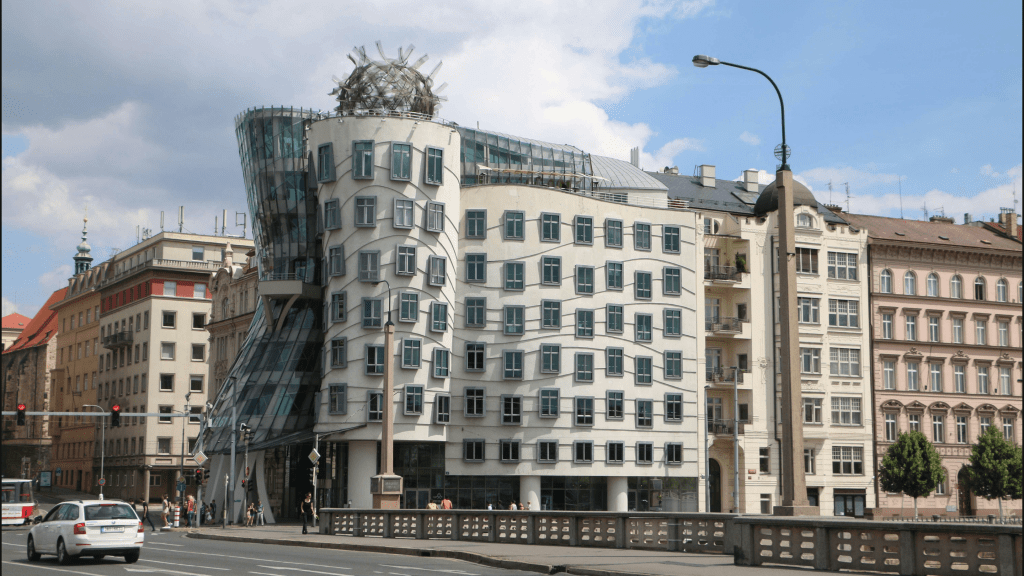
The Dancing House
Frank Gehry
While stylistically distinct, Gehry’s design maintains the scale and street wall of its neighbors, allowing the building to engage its historical context without imitation.

Fallingwater
Frank Lloyd Wright
Fallingwater responds to its natural context by embedding the house into the landscape, using local stone and cantilevered terraces to align architecture with its surrounding terrain.

Louvre Pyramid
I.M. Pei
The Louvre Pyramid introduces a modern intervention that preserves the scale, symmetry, and dominance of the historic palace through transparency rather than imitation.
The Origins of Contextualism
The thinking of context gained prominence in the mid-20th century as a response to certain strains of modernism that emphasized universal solutions for design. Glass boxes that could be placed anywhere with little regard for their surroundings.
Architectural theorists such as Colin Rowe argued that cities derived much of their character from relationships between buildings, not individual monuments. Contextualism emerged as a way to repair urban continuity and restore architectural dialogue.
Key Characteristics of Contextual Architecture
Contextual buildings often share several traits:
- Respect for scale – New buildings relate to the height and massing of their neighbors.
- Material Sensitivity – Materials may reference local traditions, textures, or colors.
- Urban Continuity – Buildings reinforce existing street patterns, plazas, and public spaces.
- Legibility within the city – Architecture contributes to the overall “reading” of the urban fabric.
These principles apply equally to urban infill projects, civic buildings, and even contemporary residential design.
Contextualism in Practice
Contextualism is more visible in:
- Historic districts, where new construction must balance preservation with modern needs
- Urban infill projects, where buildings complete existing streetscapes
- Civic architecture, where buildings are meant to symbolize shared cultural values.
In each case, the architect’s role is less about making a singular statement and more about continuing a conversation that already exists.
Contextualism vs. Copying
A common misconception is that contextualism requires replicating historic styles. In reality, contextual architecture is about response, not replication.
A contextual building might:
- Use modern materials while respecting historic scale
- Echo proportions or rhythms without copying ornament
- Reinforce street walls or public spaces using contemporary forms
Good use of context allows a building to be clearly of its time, while still acknowledging the place it occupies.
Why Contextualism Still Matters
In an era of globalized architecture, where the same building types appear in cities around the world, contextualism offers a counterpoint. When using context, a building is shaped by place, offering continuity, and being innovative without erasing the local identity.
In Simple Terms
Designing with context means architects can:
- Respond thoughtfully to their surroundings
- Respect history without being bound by it
- Strengthen the character of a place rather than overwhelm it
When done well, contextual architecture feels inevitable, as though it couldn’t exist anywhere else.
Watch: What is Contextualism? | Architecture 101
If you’d like to learn more about contextualism, you can watch the companion Architecture 101 video below.
This video pairs with the guide above and served as an introduction to broader conversations about the urban fabric, preservation, and architectural theory.
Further Reading & Sources
Go deeper into this topic
Foundational Theory
- Collage City by Colin Rowe and Fred Koetter – a key text that critiques modernist urbanism and argues for architectural continuity within the city.
- The Architecture of the City by Aldo Rossi – Explores memory, urban form, and the city as a layered cultural artifact.
Cities, Culture, and Place
- The Death and Life of Great American Cities by Jane Jacobs – Not an architectural theory book per se, but essential to understanding social and urban context.
- Genius Loci: Towards a Phenomenology of Architecture by Christian Norberg-schulz – Introduces the idea of spirit of place and architecture’s relationship to meaning and environment.
Contemporary Context
- Complexity and Contradiction in Architecture by Robert Venturi – A critical bridge between modernism, contextual thinking, and postmodern theory.
 All Things Architecture