
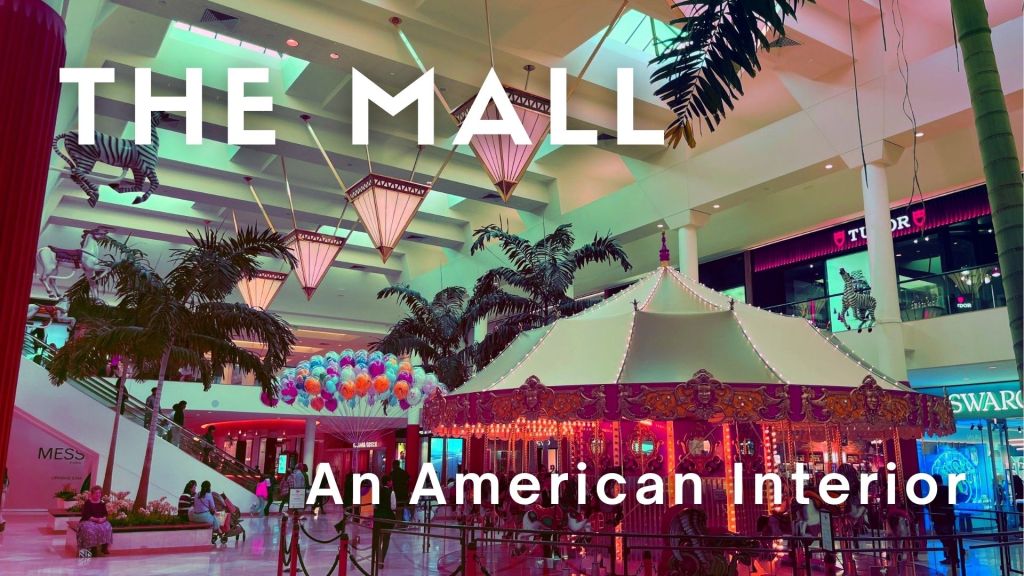
Introducing the February 2026 Issue of All Things Architecture
There was a time when architects were asked to design entire worlds dedicated to shopping, but they become something more.
These were complete environments–places where climate, light, movement, and public life itself could be shaped through architecture. The shopping mall was one of the most ambitious expressions of that idea. Within its walls, architects created interior streets, civic plazas, and gathering spaces, carefully composed and protected from the unpredictability of the city beyond.
Developments centered around shopping were nothing new when Victor Gruen arrived in the United States and began practicing in the late 1940s, from Country Club Plaza and Northgate. But when he opened Northland Center outside Detroit in 1954, he introduced something fundamentally different. Northland separated the pedestrian from the car, replacing the parking-lot storefronts with landscaped concourses, fountains, and public art. It marked the beginning of an architectural idea that would soon blossom into a defining American typology.
The most consequential leap came two years later with Southdale Center, outside Minneapolis. At Southdale, Gruen placed the functions of the shopping center within a fully enclosed, climate-controlled environment scaled entirely to the pedestrian. At its heart was a soaring atrium–and interior town square for the suburbs–where architecture created something more than a place to shop, but a place to gather.
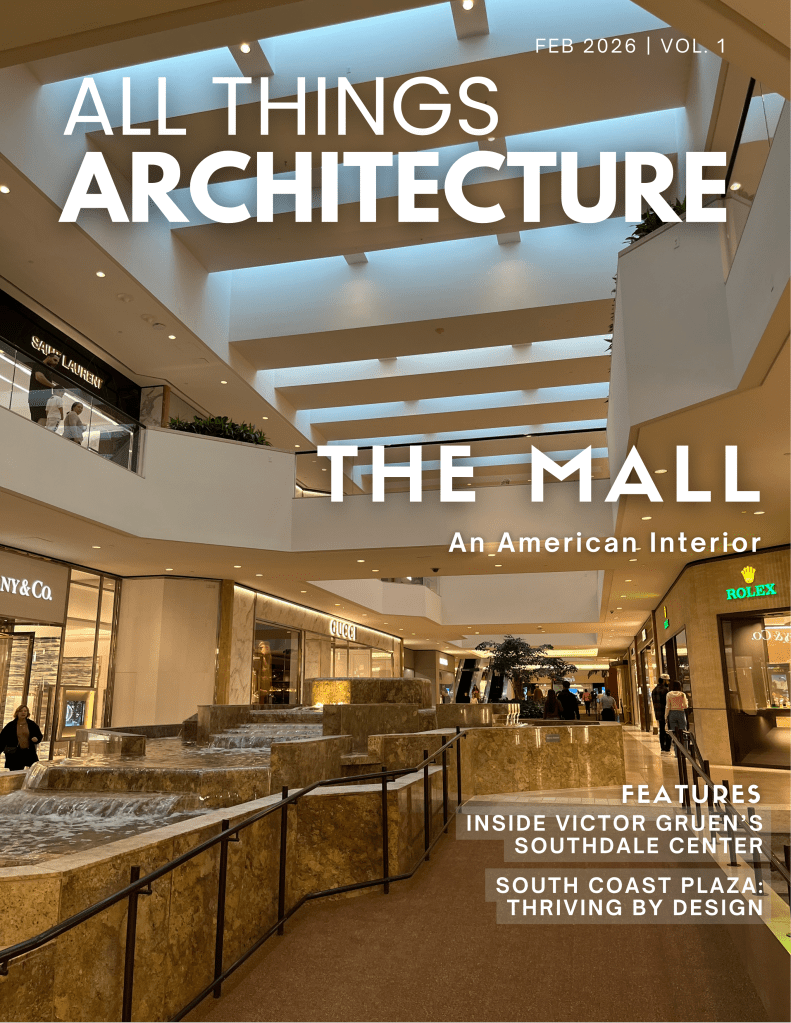
In the decades that followed, malls reshaped the American landscape. They established new patterns of movement, new relationships between interior and exterior, and new possibilities for architecture to create shared public experiences. Some, like Costa Mesa’s South Coast Plaza, redefined the model into enduring architectural institutions. Others evolved, reintroducing streets and open air through new forms like the lifestyle center. And today, many are being transformed once again, their structures adapted to serve new purposes while preserving the spatial ambition that defined them.
What remains constant is the architectural idea at the mall’s core: the creation of a complete environment.
This month, All Things Architecture celebrates the mall not as a relic, but as one of the most influential architectural inventions of the modern era. These buildings expanded the scope of what architecture could be.
What this month’s issue demonstrates is that while the mall was designed as places for shopping, they ended up becoming something far greater.

Steve Park
Editor, All Things Architecture
Explore all our mall content below
 All Things Architecture
Leave a comment