
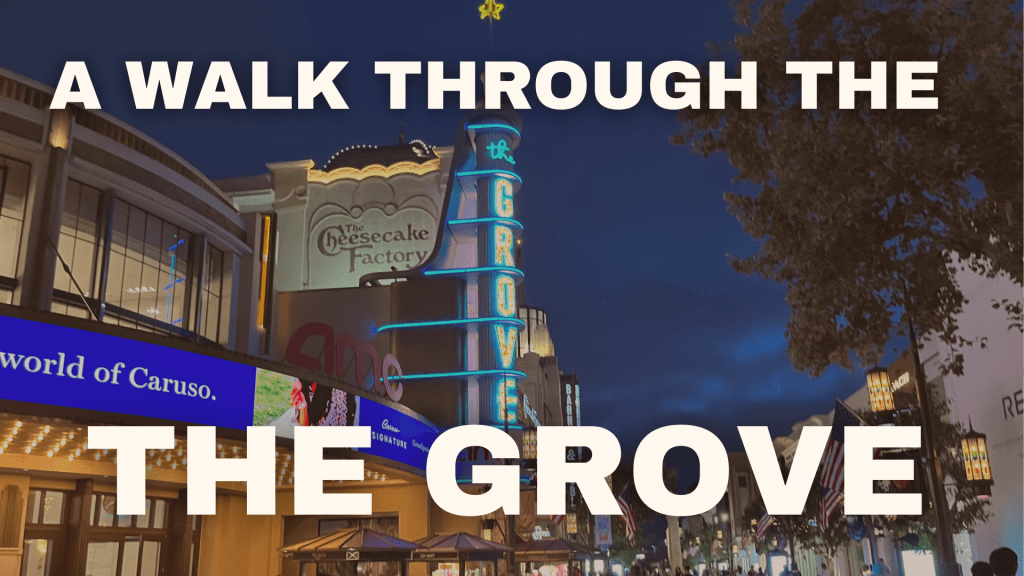
There must be something wrong with me. Here I am, having spent an hour in traffic to go to the mall, and I’m genuinely excited, because this isn’t just any mall. This is The Grove.
That excitement holds, even as someone cuts me off to dart into the parking structure, clearly intent on stealing what I assume will be the last open space. Somehow, luck is on my side. I park, step out of the car, and begin navigating the winding ramps and blind corners, doing my best to avoid getting clipped by someone late for a dinner reservation at Alma.
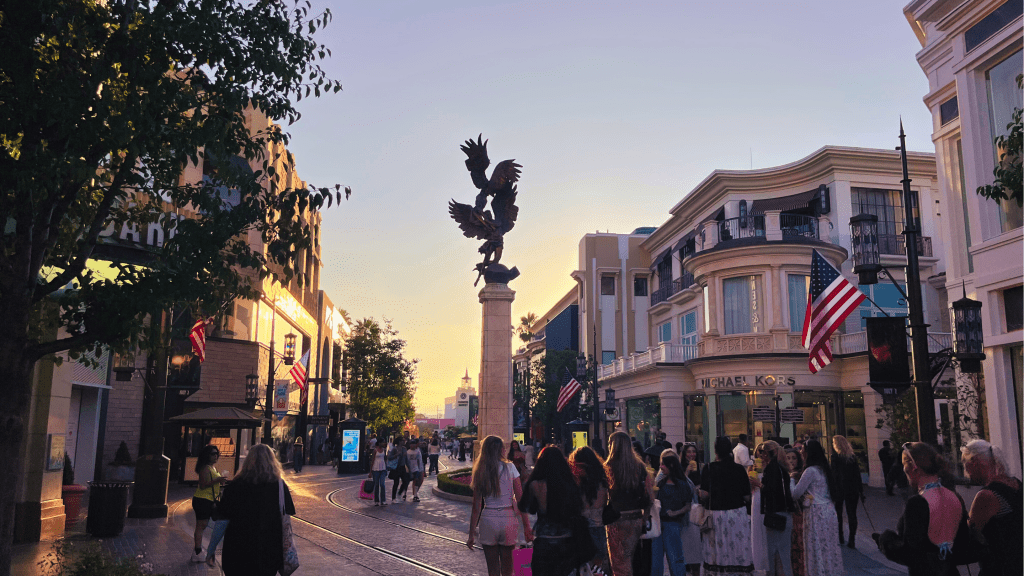
Then I hear it–Frank Sinatra, drifting softly through the air.
And despite myself, I smile.
This is supposed to feel like luxury, and for a moment, it does.
I’m not alone. My girlfriend is here too, and she’s just as excited. Like a trip to Disneyland, The Grove is one of the few places in Southern California where we’re allowed to reclaim a simple human instinct: putting one foot in front of the other and seeing where it leads. Here, walking isn’t just an obligation, but an experience,
I know how quaint that sounds. I imagine how it must read to someone in Paris or Venice–cities built on walking–to hear two Californians brimming with anticipation over the chance to stroll somewhere pleasant. But that’s the reality of Los Angeles. For all its architectural ambition, the city often makes walking feel incidental, something to be endured rather than enjoyed.
Los Angeles lives in a constant state of tension–between suburbia and city, between car culture and density–and it’s that unresolved condition, felt by nearly everyone who lives here, that makes places like The Grove so appealing.
Now more than twenty years old, The Grove is the product of local developer Rick Caruso. In many ways, he’s Los Angeles’ answer to figures like Steve Wynn in Las Vegas or Gerald Hines in Houston: developers who create places that feel obvious in hindsight, even if they don’t exist before someone decided to will them into being.
With so many shopping centers already surrounding the Fairfax District, Caruso needed to differentiate The Grove from what came before. This wasn’t going to be another indoor behemoth like the Beverly Center, nor simply an upscale outdoor mall like Century City. Instead, it would be something else entirely.
The lifestyle center.
Lifestyle centers weren’t new even in 2004. They emerged in the late 1980s as the traditional shopping mall began to fracture into different forms. Influenced by postmodern architects and New Urbanists longing for town squares, street life, and apartments over shops, this typology promised something malls were losing, that being a sense of place. Developments like Seaside and Celebration demonstrated that people still wanted to walk, linger, and window show–not just park, purchase, and leave.
Stepping out of the parking structure, the idea reveals itself immediately. Sidewalk cafes. A central green space where children run freely. Buildings scaled to pedestrians rather than drivers. Architecture that’s grand and designed to be read at walking speed.
And then there’s the fountain.
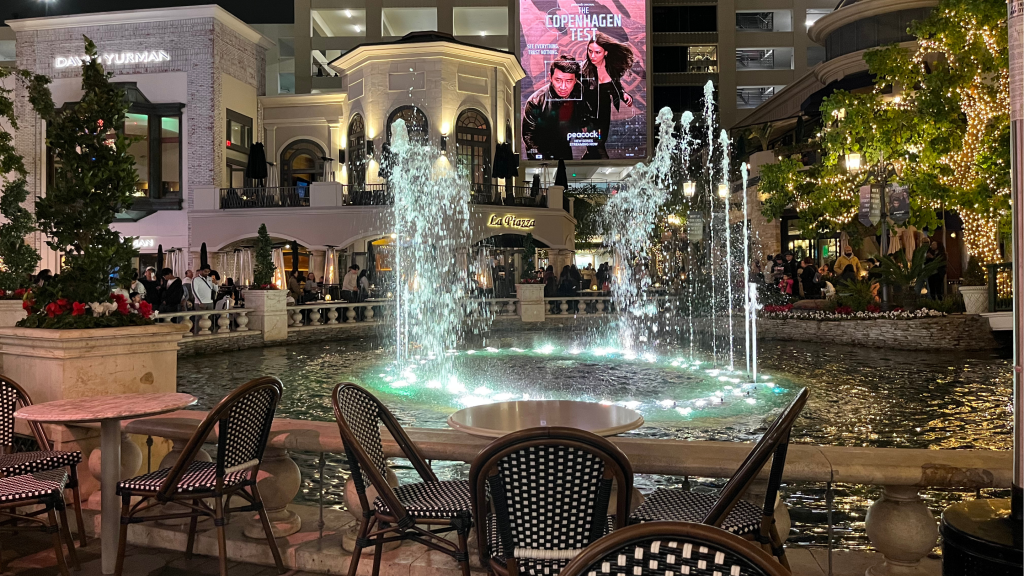
Not just any fountain, but a carefully choreographed display of water, music, and light. Your grandmother’s hometown probably didn’t have anything like this, but here it feels, surprisingly, right. Part civic space, part stage set.
I can hear my undergraduate design professor in the back of my mind, sighing in disappointment. He had dismissed this place as artificial. The buildings are scenery that lacked real historical context. It was too clean. Too friendly. Too carefully managed. No real city, he argued, behaves like this.
Years ago, I might have agreed with him. I might have wanted to prove my seriousness by rejecting a place like this outright.
Standing here now, though, I have to admit something simpler: I like it.
Maybe it’s the cleanliness. Maybe it’s the friendliness. Maybe it’s the fact that former Disney Imagineers helped shape a place designed, quite unapologetically, to make people feel welcome. Or maybe it’s just the quiet pleasure of being somewhere that wants you to stay a while.
Yes, there’s a Cheesecake Factory. Yes, people are debating aura compatibility over $300 dresses. But there’s something undeniably satisfying about moving through a space that encourages lingering rather than efficiency.
As I walk along the main promenade, a question begins to surface. If this isn’t “real” urbanism, then what exactly am I experiencing? If this isn’t architecture, then why do these spaces still produce moments of delight?
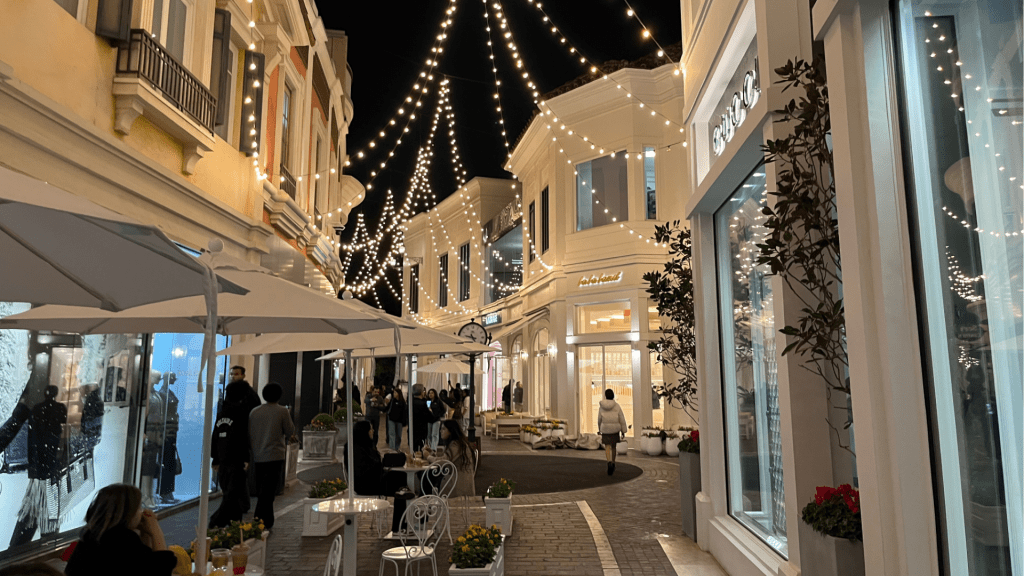
Perhaps the distinction between “real” and “fake” matters less than we think. To the people around me–families, couples, tourists, locals–this place is undeniably real. It’s woven into routines, memories, and everyday life, imperfectly connected to the surrounding city, but connected nonetheless.
After some shopping, we cross the street to the original Farmers Market for dinner, then continue on to Trader Joe’s groceries. It isn’t a grand urban gesture, but it is continuity, walking stitched into daily life in a city where that’s often difficult to come by.
Leaving The Grove and reentering the surrounding streets, its shortcomings become clearer. Blank facades. Entrances that turn inward. A development that still behaves, at times, like a wall. But that condition isn’t unique to this place, it’s endemic to Los Angeles.
What stays with me instead is the realization that good design doesn’t have to come from a manifesto or a starchitect. It can come from remembering how people like to move, gather, and explore. From creating places that feel legible, welcoming, and generous, spaces that invite people to look up and stay curious.
So while some critics will continue to dismiss The Grove as a “fake downtown,” I’ll keep braving the traffic and making the trip to a place that offers something the city too often withholds: the simple pleasure of exploration, the comfort of friendly spaces, and an architectural environment designed around people rather than movement alone.
And besides, they have a trolley.
What’s not to love?
 All Things Architecture
Leave a comment