
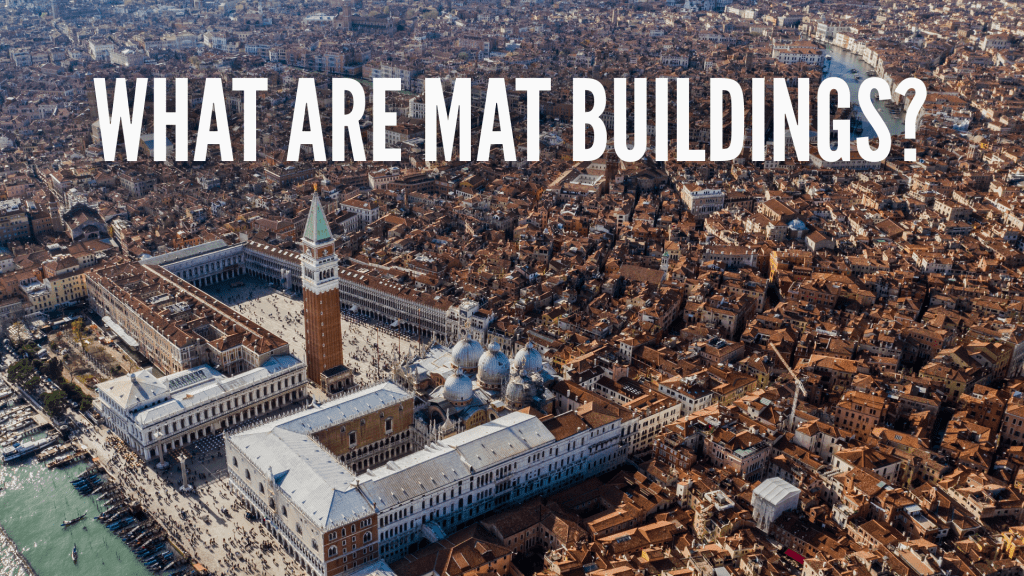
Imagine a city that grows not upwards, or outward in never-ending sprawl, but across the ground in a carefully crafted cellular pattern. This idea is the basis for an often overlooked concept in urban planning and architecture called the “mat building.”
At its core, a mat building is less about height and monumentality, and more about horizontal spread, adaptability, and connection. It’s an architectural form that resists hierarchy, instead favoring repeatable units and open-ended growth. That allows the architecture to recede and let the life of in inhabitants come to the forefront. It was a concept that was nothing new, given the way cities were built throughout history, with tightly, meandering streets and buildings clustered together at a human scale. An aerial view of Middle Eastern cities demonstrates this concept.
The term was first coined in 1974 by Alison Smithson, one of the founders of brutalism in Britain, in her essay “How to Recognize and Read Mat-Buildings.” She described them as “buildings in which the function comes to enrich the fabric and the individual gains new freedoms of action through a new and shuffled order.”
Smithson and others began thinking of new concepts in urban planning among the struggle to rebuild European cities following WWII. Smithson and others rejected ideas pushed by modernists like Le Corbusier, which envisioned cities as functional towers with parks in between.
Early adopters of this concept began appearing as early as the 1960s, with Aldo van Eyck’s design for an orphanage in Amsterdam, with a low, sprawling complex of interconnected courtyards and room.
Candilis-Josic-Woods designed the Free University of Berlin, easily the most famous examples of the concept. It resembled a labyrinthine grid of repeatable modules, designed to accommodate growth and change. It wasn’t about a single monument, but rather a single organism.
Even Le Corbusier, once against the idea, played with the concept for his Venice Hospital Project in the mid-1960s. It was a horizontal, modular system of courtyards surrounded by wards. It was designed to expand as needed, but it was never built.
Jørn Utzon designed the Kuwait National Assembly in the 1970s. While the assembly hall itself was a monumental structure, the surrounding complex embodied the qualities of a mat building, with repeating units under a unified roof.
While there were plenty of theoretical plans utilizing a mat building concept, by the late-20th century, the mat building as a formal idea waned. The reality was there concepts were dependent on large swaths of virgin land to be successful. Also, at ground level, the modular structures could feel repetitive. As the 1990s came around, a growing desire for density, which made architects favor verticality.
That’s not to say that the concept of a mat building hasn’t inspired recent buildings. The Rolex Learning Center by SANAA emphasizes a continuous, flowing space under a single structure that’s broken up with outdoor spaces.
While the number of built examples is small, the legacy of the mat building remains important. They taught us that architecture doesn’t have to be about isolated objects, but it can be about networks and adaptability. In many ways, the logic of the mat building anticipated today’s concerns with flexibility, mixed-use environments, and urban integration.
Look closely at contemporary architectural discussions where terms like “field conditions” and “non-hierarchical design” echo the ideas of the mat buildings.
So, what’s the less of the mat building, then? It’s that architecture doesn’t always need to reach for the sky. Sometimes, the most radical thing a building can do is spread across the ground, weaving people and space together into a living tapestry.
 All Things Architecture
Leave a comment