

For nearly half a century, modernism ruled with an iron grip. Buildings were to be functional, stripped of excess, obedient to geometry. Ornamentation was outlawed, history erased. “Ornamentation is a crime,” declared Adolf Loos. “Less is more,” preached Ludwig Mies van Der Rohe. Their words became gospel, seducing a generation of architects into a utopian promise of efficiency and order.
But no orthodoxy lasts forever. By the late 1960s, cracks began to appear. A new generation whispered of color, irony, and play. They wanted ornamentation back. They wanted history back. They wanted freedom. When their rebellion broke through, it came with a slogan as cheeky as it was radical: “Less is a bore.”
Postmodernism had arrived, and architecture would never be the same.
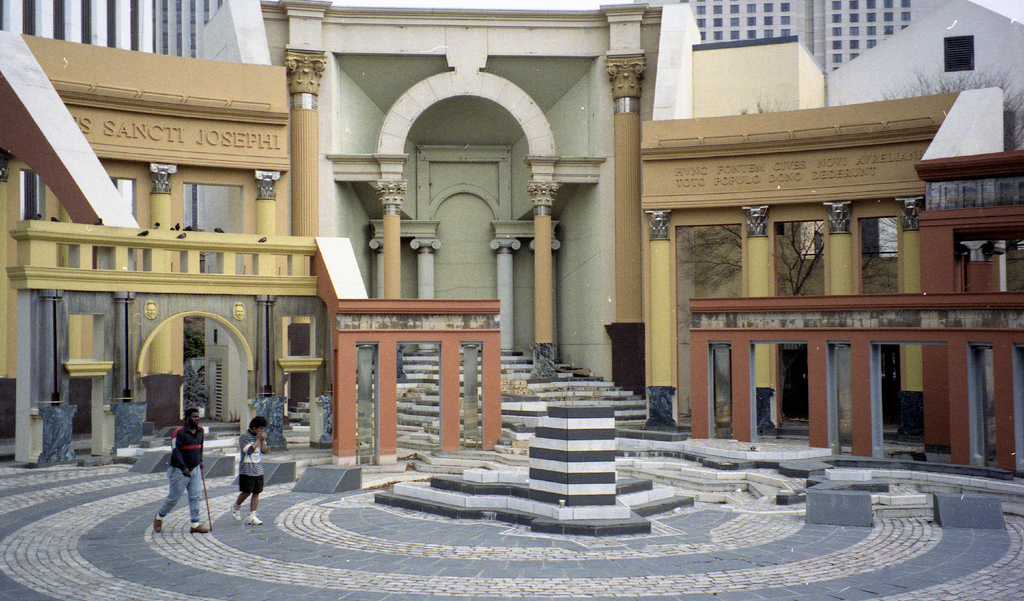
From Charles Moore’s Piazza d’Italia to Michael Graves’ Portland Building, the movement was defined by playful references, pastel colors, and exaggerated forms. Columns, pediments, and arches reappeared–but they were remixed, resized, and reinterpreted in bold and often absurd ways. Buildings no longer whispered the language of pure function.
The intellectual spark came earlier, with Robert Venturi’s Complexity and Contradiction in Architecture (1966). Venturi argued for symbolism, pluralism, and context–a rejection of the International Style’s sterile universality. His Venturi House, designed for his mother n 1962, embodied contradiction: a gable roof that wan’t really a roof, a chimney that wasn’t really a chimney, a facade that looked symmetrical but really wasn’t. Later, with his wife Denise Scott Brown and Steven Izenour, Venturi codified these ideas in Learning From Las Vegas (1972), contrasting the “Duck” (a building that is its meaning) with the “Decorated Shed” (a plain building whose meaning comes from signs and symbols).
Architectural critic Charles Jencks gave the movement its name with The Language of Post-Modern Architecture (1977). He introduced “dual coding” – the idea that buildings could speak to both experts and the general public. In other words, architecture could be serious and witty, elitist and populist, ironic and sincere.
By the 1980s, postmodernism became mainstream. Graves’ Humana Building in Louisville offered corporate America a symbol-rich alternative to the modernist glass boxes. Graves carried this to another corporate client–the Walt Disney Company. His headquarters for the company in Burbank featured the Seven Dwarfs holding up a classical pediment. Graves was one of several architects hired by Disney to design a number of high-profile buildings, from hotels, gas stations, and even master-planned community.
Philip Johnson, once modernism’s great evangelist, shocked the profession with his AT&T Building in 1984, stopped with a Chippendale-inspired pediment. James Stirling’s Neue Stattsgalerie in Stuttgart balanced stone grandeur with playful colors and ramps. In London, Terry Ferrell crowned TV-am Studios with giant eggcups and later gave MI6 a monolithic headquarters. Across the globe, Richard Bofille, Kengo Kuma, and Frank Gehry pushed postmodernism into ever stranger, more theatrical territory.

By the 1990s, postmodernism’s counterculture attitude had slipped into corporate pastiche. Critics like Ada Louise Huxtable dismissed it as gimmickry, arguing that architecture had traded substance for cartoonish excess. Philip Johnson himself abandoned it for deconstructionism, co-curating MoMA’s 1988 exhibition on the emerging style. The symbolic final curtain came in 1997 with Frank Gehry’s Guggenheim Bilbao. Its shimmering titanium curves dazzled the world and reset the bar for architectural spectacle. Postmodernism suddenly looked old.
Many of its landmarks have since been remodeled, demolished, or quietly ignored. Yet its legacy remains. The skyline of Dubai, the flamboyance of Macau, and even today’s pluralistic debates over context and symbolism all owe something to postmodernism’s refusal to take architecture too seriously.
At its best, postmodernism reminded us that buildings aren’t just machines for living. They’re stages for life.
So next time you walk past a postmodern building–whether you laugh, cringe, or marvel–remember then architects who dared to break the rules and say: Less is a bore.
 All Things Architecture
Leave a comment