
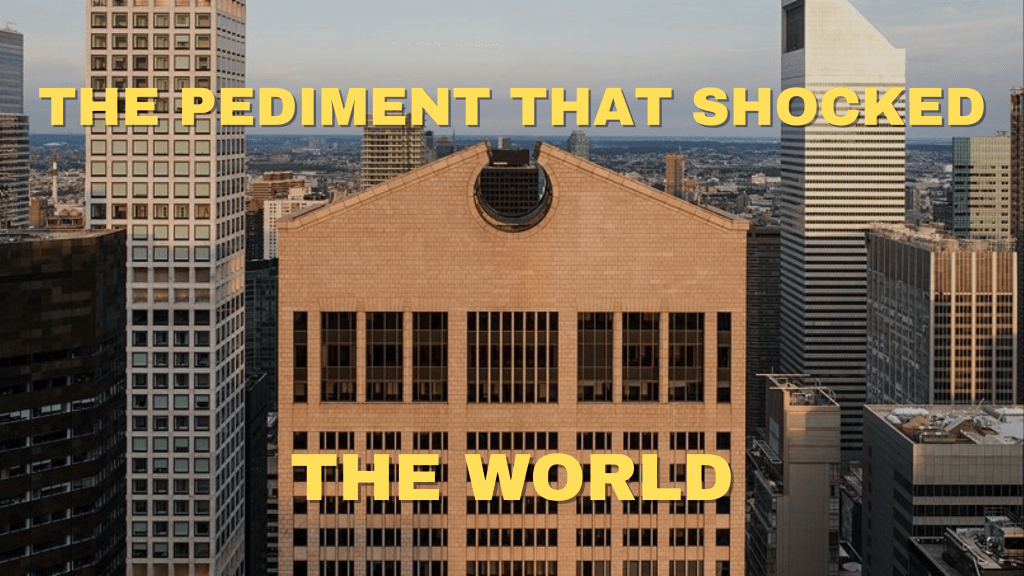
In 1984, a skyscraper rose over Midtown Manhattan that left New Yorkers scratching their heads. Some admired it. Others hated it. But no other ignored it. At 37 stories tall, the AT&T Building by Philip Johnson and John Burgee wasn’t just another glass box. It was a direct challenge to decades of modernist dominance.
For nearly forty years, modernism–specifically the International Style–had ruled the skyline. Corporate America loved it for its clean efficiency, and architects delivered. The result was skylines that looked nearly identical across the globe.
Just as Johnson had once introduced the world to the International Style, his AT&T Building introduced the corporate world to postmodernism. He broke the rules: instead of a flat roof, Johnson wanted a top that stood out on the skyline. As John Burgee later explained, the pediment was born from the site’s limitations and the building’s proportions–its shape was almost inevitable. But by breaking the pediment, they also broke architectural convention.
To some, the result was whimsical. To others, it was blasphemy. Ada Louise Huxtable, the legendary architecture critic, called it “a monumental act of vandalism.” Yet to Johnson, it was liberation. The pediment was proof that buildings could speak again–about history, style, and culture. It was a building that looked backward as a way of move forward.
With its star architects and prominent location along Madison Avenue, the building became an instant icon of the postmodern movement. For clients, it was also proof there was no such thing as bad publicity. Postmodernism generated headlines built brand identity.
AT&T eventually left, and so did its next owner, Sony. For a time, it seemed this icon of postmodernism might be erased when developers threatened to renovate it beyond recognition. But preservationists fought back, and the building served. Today, it stands as one of the most recognizable examples of its era. Love it or hate it, that broken pediment helped change the course of architectural history–and we’re better for it.
 All Things Architecture
Leave a comment