

Rising out of the Mojave Desert like an electronic jewel is the Las Vegas Sphere. When it opened in 2023, it captured the attention of the world with its crystal-clear LED images that enveloped the entire structure. It blurred the lines between the digital world and the physical world. The building is now a completely dynamic structure, capable of morphing in front of us. It’s the latest example of an emerging style of architecture where technology, new media, and architecture combine called media architecture. Though considered new, it’s origins dates back decades and its potential for redefining our built environment is profound.
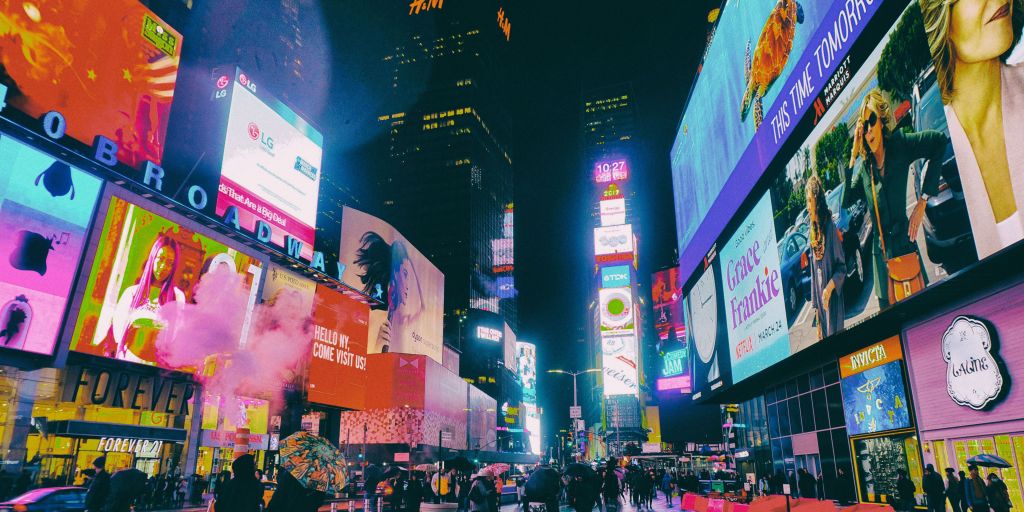
Traditionally, the term media architecture was use to describe so-called urban screens like those found in New York’s Times Square, but the term has expanded to include everything from projection mapping, public art displays, and any interactive elements that incorporated technology into the built environment.
Media architecture is communication through light. It’s not an entirely new concept. Robert Venturi wrote extensively about the communicative aspect of architecture in his book Iconography and Electronics Upon a Generic Architecture, where he compared modern urban screens with the stained-glass windows in gothic cathedral communicating to churchgoers the teachings of the Catholic Church.
Once electricity became prominent across the globe, its incorporation into the built environment as a form of communication was inevitable. At the 1882 Paris International Exposition, Thomas Edison’s company displayed the first electric sign. It was a captivating novelty at the time, and the technology would soon find its way around the world. Nowhere was this more prevalent than in New York City. It was there that early electric signs dotted the landscape, including Times Square.
Some were not big fans of these signs. The writer William Dean Howells commented in 1896 that “it seemed as if the signs might eventually hide the city.” Despite the critics, the signs continued to spring up. By 1928, a new kind of signage was installed. The Motograph News Bulletin, known to locals as the Zipper, rotated the latest headlines with the help of 14,800 bulbs near the base of the Times Tower Times Square. Ushering in a new era.
Between incandescent and neon signage, cities became a collage of information. One of the cities that demonstrated this best was Las Vegas of the 1950s. Its energetic midway of signs and flashy casinos brought the combination of architecture and signage to its natural conclusion. Its impact was so great that it became the basis of Robert Venturi and Denise Scott Brown’s book Learning from Las Vegas from 1972, which explored the ways architecture conveyed information.

Up to this point, media, whether it was signage or lighting design was more or less an afterthought. That changed as technology expanded in the 1990s. Now, the idea of media and architecture being developed in tandem began to form. Times Square saw this change in the 1990s, when the firm Gwathmey, Siegal and Associates designed the Morgan Stanley Building. It featured rows of digital zippers displaying up-to-the-minute stock prices and news headlines along its base, one of the first examples of what would eventually become media architecture.
Taking this one step further, the redevelopment of 1500 Broadway in 1999 by Disney Imagineering saw the idea of playing with news zippers to add a greater sense of movement as the words moved along the undulating facade.
At the Kunsthaus Graz, architects Peter Cook and Colin Fournier created a blob-like structure that had embedded in its facade a grid of fluorescent lights called the BIX facade. It turned the facade into a canvas for abstract images.
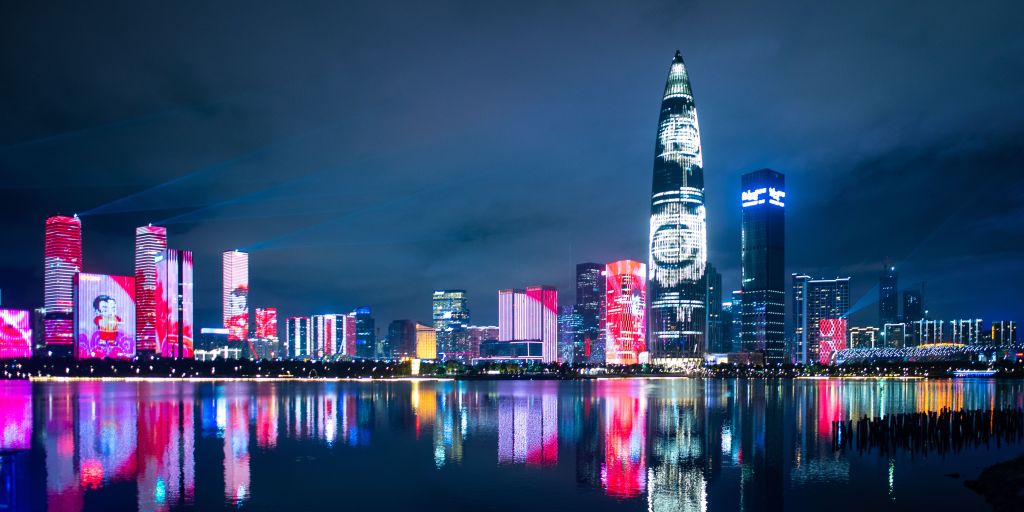
Shenzhen, China raised the bar on what was possible with media architecture by developing a symphony of lights with the help of 49 skyscrapers around the city’s civic center. It is a moving mosaic where images move as seamlessly as possible between skyscrapers. It has become one of the city’s biggest tourist attraction.
As of late, cities around the world have seemingly embraced the concept of media architecture to redefine the urban experience into a more vibrant one, but there is the question of whether or not these displays are meaningful improvements to the built environment, or are they novelties?
There are genuine concerns about the sustainable of these projects. In the case of the Las Vegas Sphere, it takes roughly 28 megawatts, the equivalent of 21,000 homes, to power the entire building. Though, the Sphere points out that seventy-percent of that energy comes from solar, most projects being built aren’t. Times Square alone requires 35 megawatts of power. It will take some time for new, more energy efficient urban screens to reach the market to bring those numbers down.
There’s also the question of what’s displayed on these large urban screens. While cities throughout the world offer programs for artists to display their work at such a large scale, most of the times they are consumed by advertisements. Is it in the best interest of cities today to be dominated with such large ads? And with every inch of a building’s facade seen as an advertisement space, will the majority of our buildings take on the form of One Times Square covered in ads?
The short answer is probably not. These new technologies and ideas won’t replace the traditions of the built environment. They are instead new tools that can be applied to help enhance architecture. Of course, it comes down to creative architects and designers to apply such tools in thoughtful ways.
Learn more about Media Architecture below:
 All Things Architecture
Leave a comment